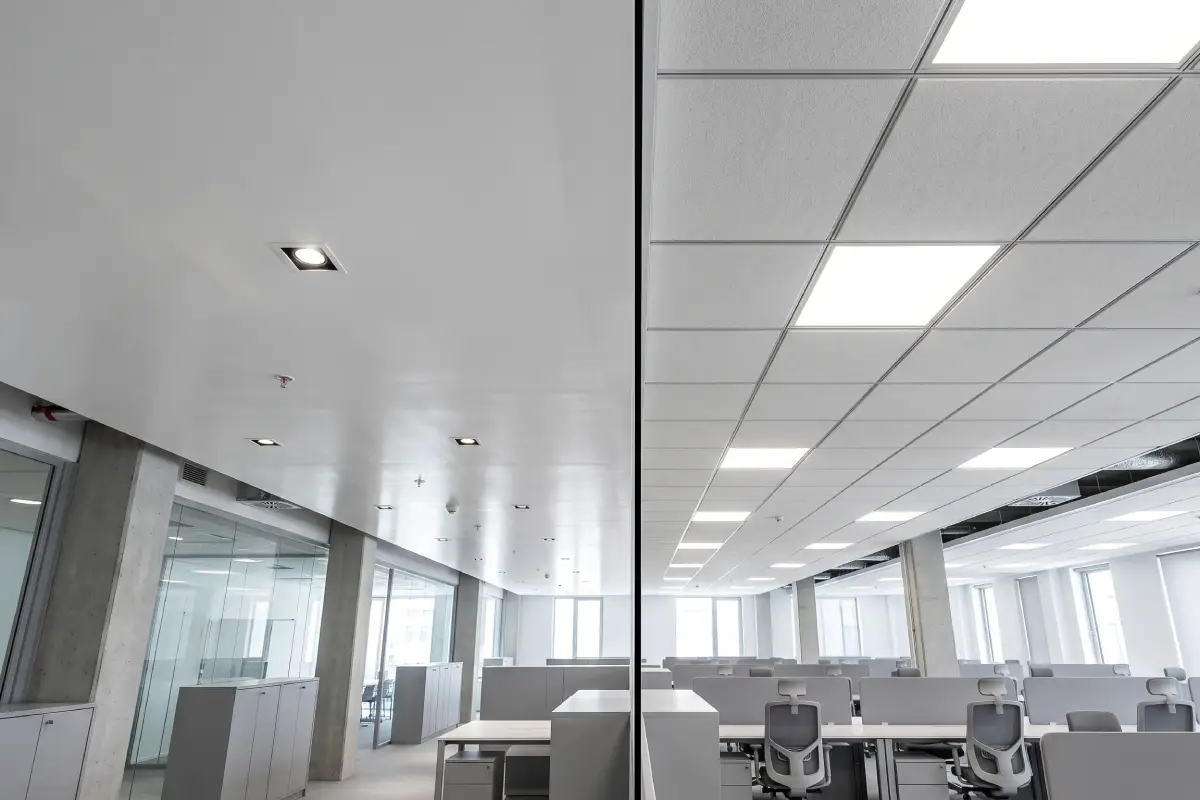
A plain plasterboard ceiling absorbs roughly 5 to 15 per cent of the sound that hits it. A fibreglass acoustic panel absorbs up to 95 per cent. That gap is the difference between a room that feels calm and one that leaves people drained by mid-afternoon.
Acoustic ceilings use porous or perforated materials that trap sound waves instead of bouncing them back into the space. The material you pick changes how the room performs, what it costs, and whether it passes Australian fire rules.
Patching a cracked wall or ceiling is usually a simple repair, but sagging, repeated cracking, or a room that never stops echoing points to the material itself, not just the surface.
Quick answer: There is no single best acoustic ceiling material. Your choice hinges on one question: are you absorbing echo inside a room, or blocking noise between rooms? For echo, fibreglass and thicker PET felt lead on absorption. For privacy between rooms, denser mineral fibre plus roof-void treatment does the work. Timber and metal buy the look, and foam belongs in a studio, not a commercial ceiling.
Key takeaways
- Two ratings matter, not one: NRC measures echo absorbed inside a room, CAC measures noise blocked between rooms.
- A high NRC does not mean a ceiling stops noise reaching the room next door.
- In Australia, ceiling linings must meet an NCC fire Group Number, so ask for the certificate before you buy.
- Indicative installed cost runs from about $50/m² for mineral fibre to $200/m² for timber.
- Name the acoustic problem first, then the material follows.
What makes a ceiling “acoustic”?
Two different numbers describe ceiling acoustics, and confusing them is the most expensive mistake buyers make.
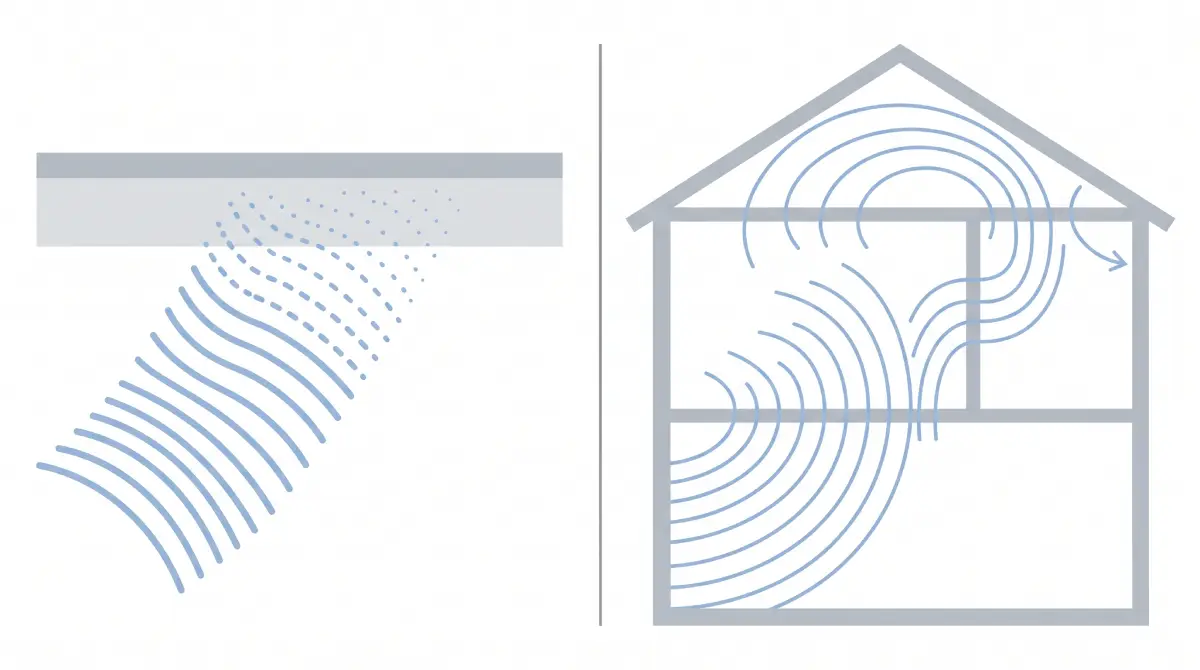
The Noise Reduction Coefficient (NRC) measures how much sound a surface absorbs, from 0.00 (total reflection) to 1.00 (total absorption). It averages the speech frequencies of 250, 500, 1000 and 2000 Hz. A higher NRC means less echo and reverb inside the room.
The Ceiling Attenuation Class (CAC) measures something else: how well the ceiling stops sound travelling up into the roof void and back down into the room next door. A CAC below 25 is weak, and 35 or above blocks sound well between spaces.
Here is the trap. A material can score a high NRC and a low CAC at once. Fibreglass absorbs sound beautifully inside a room but is light and open, so noise passes between rooms. Denser mineral fibre absorbs a little less but blocks room-to-room transfer far better.
So name your problem before you look at any product. Fixing echo in one open room is an NRC job. Stopping conversations bleeding between closed offices is a CAC job. Rooms that need both usually mean combining materials.
Which materials compare best?
Each material trades absorption, noise blocking, looks, cost and fire performance differently. Here is where each one wins.
Mineral fibre tiles
- Best for: budget offices, schools and retail on a standard grid.
- NRC: 0.50 to 0.70, up to about 0.85 for premium fissured grades.
- Blocks room-to-room noise: moderate, thanks to its density.
It is the default tile in Australian suspended ceilings: cheap, available and naturally fire-resistant. The downside is a plain look unless you pay for a designer face, and a tendency to sag or mark in high humidity.
Fibreglass panels
- Best for: auditoriums, studios and meeting rooms where echo control is critical.
- NRC: 0.75 to 0.95, up to 1.00 for suspended clouds.
- Blocks room-to-room noise: weak.
A compressed glass-fibre core gives the highest absorption in the category across both high and low frequencies. Its low density resists moisture and sagging but does little to stop sound passing between rooms, and it dents easily.
PET (polyester) felt
- Best for: design-led offices, classrooms and healthcare interiors.
- NRC: 0.75 to 1.00, depending on thickness.
- Blocks room-to-room noise: weak to moderate.
Pressed from recycled plastic bottles, PET is lightweight, cuts cleanly, carries no fibre irritation hazard and takes printing and colour. Thin decorative versions absorb less, so specify the thickness the room needs, not the slimmest panel.
Perforated timber and wood wool
- Best for: feature ceilings, hospitality, gyms and sports halls.
- NRC: 0.60 to 0.80, set largely by the backing behind the panel.
- Blocks room-to-room noise: low to moderate.
Timber gives a warm, premium finish while the absorptive backing does most of the acoustic work. Wood wool, made from cement-bonded wood fibre, adds a rugged, impact-tough surface for high-traffic areas.
Perforated metal
- Best for: lobbies, transport hubs and wet or high-traffic areas.
- NRC: up to about 0.70, depending on the backing.
- Blocks room-to-room noise: low.
Sound passes through the holes into an acoustic fleece or mineral infill. Metal is durable, washable and architecturally clean. It is non-combustible, but coatings and backings still affect the fire rating of the whole system.
Acoustic (perforated) plasterboard
- Best for: spaces wanting a flush, painted finish without a visible tile grid.
- NRC: 0.05 to 0.15 plain, considerably higher for perforated grades with mineral backing.
- Blocks room-to-room noise: moderate to good.
It keeps a seamless plaster look while still absorbing sound. Installation is more involved than dropping tiles into a grid, which raises the labour cost.
Acoustic foam
- Best for: home studios and vocal booths only.
- NRC: 0.65 to 0.80 at 50 mm, mostly mid and high frequencies.
- Blocks room-to-room noise: very weak.
It keeps a seamless plaster look while still absorbing sound. Installation is more involved than dropping tiles into a grid, which raises the labour cost, so it pays to get a plasterer experienced with acoustic-rated systems, such as Pro Plaster N Paint in Sydney, to quote the job rather than a general handyman.
Material comparison table
| Material | Typical NRC | Blocks room-to-room noise? | Indicative installed cost (AUD/m²) | Best suited to |
| Mineral fibre tiles | 0.50–0.70 (up to 0.85) | Moderate | $50–$90 | Offices, schools, retail on a budget |
| Fibreglass panels | 0.75–0.95 | Weak | $60–$100 | Auditoriums, studios, meeting rooms |
| PET (polyester) felt | 0.75–1.00 | Weak to moderate | $97–$134 | Design-led offices, classrooms, healthcare |
| Perforated timber / wood wool | 0.60–0.80 | Low to moderate | $100–$200 | Feature ceilings, hospitality, sports halls |
| Perforated metal | up to 0.70 | Low | $70–$120 | Lobbies, transport hubs, wet or high-traffic areas |
| Acoustic plasterboard | 0.15+ (perforated grades higher) | Moderate to good | $70–$150 | Flush plaster finishes without a tile grid |
| Acoustic foam | 0.65–0.80 | Very weak | Low | Home studios and vocal booths only |
Costs are indicative supply-and-install ranges from Australian trade guides and suppliers. They shift with room size, ceiling height, city and finish, so always get a site-specific quote.
Do acoustic ceilings need a fire rating in Australia?
Yes. Wall and ceiling linings must meet a Material Group Number under the National Construction Code, and skipping this can stop a fit-out at inspection.
Group Numbers run from 1 to 3, and a lower number means better fire performance. Group 1 performs best and can go almost anywhere, while high-risk areas such as exits and healthcare spaces demand it outright.
Products are tested to AS 5637.1:2015 using a full-scale room burn based on AS ISO 9705. Perforated and multi-layered products, which cover most acoustic panels, must be assessed as a complete system rather than by the raw material alone. The Australian Building Codes Board sets out the exact clause requirements under NCC Specification C1.10 if you want to check the fine print yourself.
So do not assume a material is compliant because it looks fire-safe. Ask the supplier for the Group Number and fire test certificate for the exact system, including its backing and coating. A reputable manufacturer provides both on request.
What do acoustic ceilings cost in Australia?
Expect roughly $60 to $100 per square metre supplied and installed, with the material and setting moving that figure up or down.
Basic suspended mineral fibre grids sit at the lower end, around $50 to $80 per square metre. Metal ceilings run $70 to $120, and timber feature ceilings climb to $100 to $200 depending on species and finish.
Drop-in PET tiles from Australian suppliers have been quoted around $97 to $134 per square metre. Labour adds up separately at roughly $55 to $85 an hour, with Sydney and inner-Melbourne rates higher than regional areas.
How do I match the material to my room?
Start with the acoustic problem, not the product. The problem points straight to the material.
- Echo in one open room (open-plan office, classroom): chase a high NRC with PET felt or fibreglass, and stop worrying about CAC.
- Speech privacy between closed offices: CAC matters most, so use denser mineral fibre and treat the roof void. A light high-NRC panel alone will not stop the leak.
- A feature space on show: timber or perforated metal give the look while a good backing carries the acoustics.
- Wet, humid or high-traffic areas: favour moisture-resistant, washable options, since mineral fibre can sag in humidity.
- Sustainability or air-quality briefs: PET felt stands out with recycled content, no fibre irritation and low-VOC finishes.
- Tight budget on a grid retrofit: mineral fibre remains the sensible default.
The verdict
There is no single best material for an acoustic ceiling. The right choice hinges on one question above all: are you absorbing echo inside a room, or blocking noise between rooms?
For echo control, fibreglass and thicker PET felt lead on absorption. For noise blocking, denser mineral fibre and proper roof-void treatment do the work. Timber and metal buy you the look, plasterboard buys a flush finish, and foam belongs in a studio.
Whichever you lean towards, confirm the NCC Group Number and fire certificate before you commit, and get a site-specific quote rather than trusting an average. Name the problem first, then the material follows.